.png)
.png)
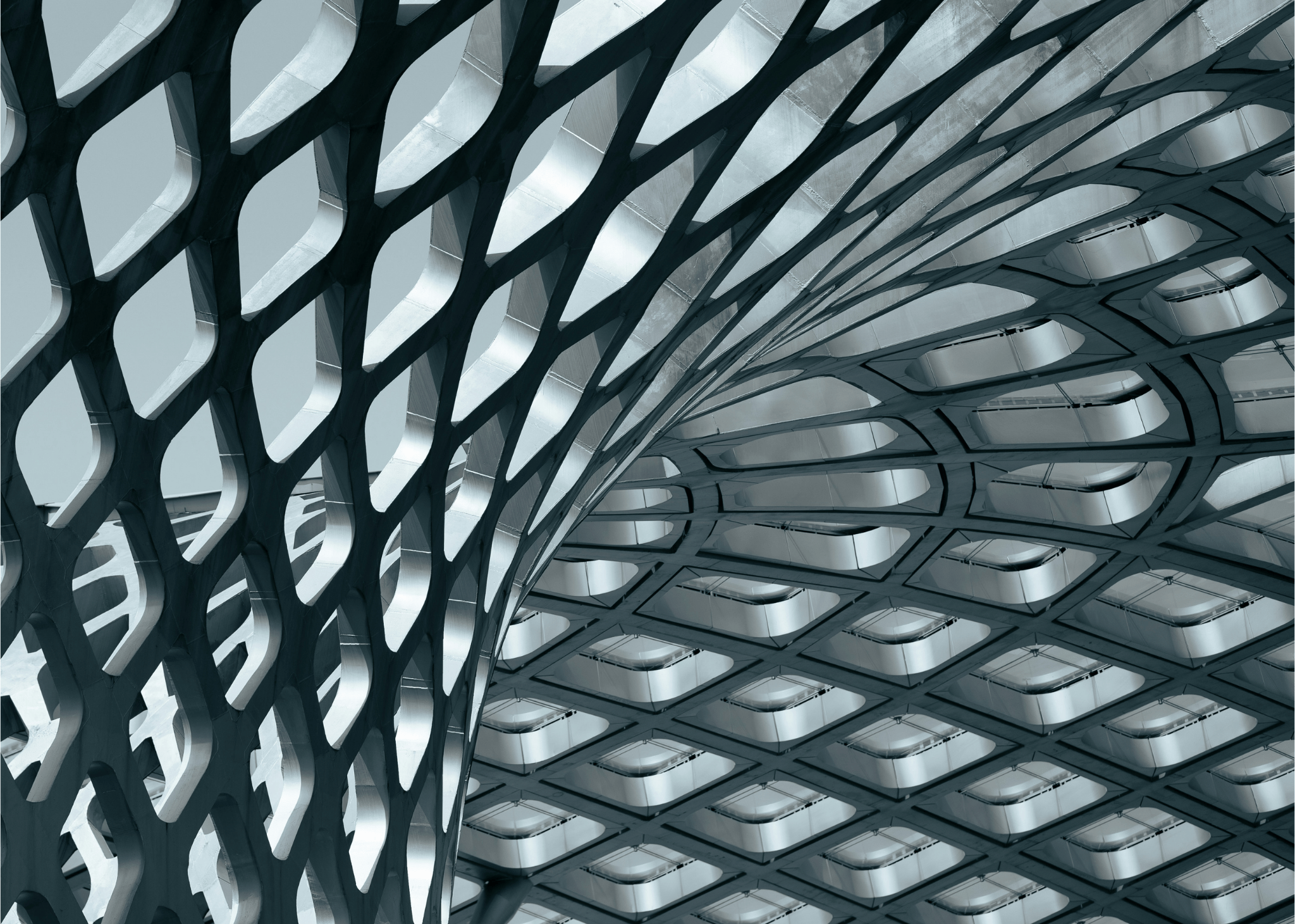
Freeform architecture has moved from conceptual sketches to buildable reality largely because structural engineering has developed the computational tools to keep pace. Parametric structural design treats geometry, material behavior, and load response as interconnected variables within a single logical model, allowing engineers to explore, analyze, and refine complex forms far faster than traditional iterative drafting ever allowed. This article looks at how parametric workflows, computational form-finding, and optimization algorithms are reshaping the relationship between architectural ambition and structural feasibility.
Traditional structural design follows a largely linear sequence: an architect proposes a form, and an engineer verifies it against code requirements. Parametric design inverts this relationship by embedding structural logic directly into the geometric model. Every surface, curve, and node is defined by parameters and relationships rather than fixed coordinates, so a single change, whether to a column grid, a curvature radius, or a material thickness, propagates automatically through the entire model. This associative logic allows architects and engineers to test dozens of geometric variations in the time it once took to evaluate one, without discarding the analytical rigor that governs safe construction.
Many freeform structures, including gridshells, tensile membranes, and shell roofs, are most efficient when their geometry follows natural force-flow patterns rather than arbitrary sculptural curves. Form-finding methods such as dynamic relaxation, force density, and particle-spring simulation allow engineers to generate geometry that resolves loads primarily through axial tension or compression, minimizing the bending stresses that drive up material use and member depth. Rather than analyzing a fixed shape after the fact, form-finding lets structural behavior generate the shape itself, producing forms that are simultaneously expressive and inherently efficient.
Visual scripting environments such as Grasshopper for Rhino, paired with structural plug-ins like Karamba3D, along with Dynamo for Revit and dedicated finite element solvers, have become the connective tissue of parametric structural practice. These tools allow engineers to build a single associative model that links geometry generation directly to real-time structural analysis, so that member sizing, deflection checks, and buckling verification update automatically as the design evolves. Interoperability between these platforms and building information modeling environments helps structural intent survive the transition from concept model to construction documentation.
Freeform geometry rarely optimizes for structure alone. Architectural intent, daylighting, acoustics, fabrication cost, and material efficiency often pull design variables in different directions. Genetic algorithms and multi-objective optimization tools, such as Galapagos, Wallacei, and Octopus, allow engineers to search vast design spaces for solutions that balance competing criteria simultaneously, surfacing trade-offs that would be impossible to identify through manual iteration. Rather than producing a single answer, these tools generate a population of viable design options, giving the design team a clearer picture of the cost of pursuing more expressive geometry.
Parametric workflows also change how architects and engineers collaborate. When both disciplines work from a shared associative model rather than exchanging static drawings, structural feedback becomes a continuous input to design rather than a late-stage constraint. Engineers can flag geometry that concentrates stress or increases member count early enough for architects to adjust the form while design intent is still flexible, reducing the costly redesign cycles that freeform projects have historically suffered from.
Freeform structures are rarely composed of identical repeating elements, which makes fabrication planning a structural concern as much as a construction one. Parametric models can automatically generate shop drawings, panelization schemes, and connection details for hundreds or thousands of unique members, while flagging elements that fall outside fabrication tolerances or standard material stock. Direct data exchange between the structural model and CNC cutting, robotic fabrication, or 3D printing systems shortens the path from design intent to physical component, reducing manual interpretation errors that are especially costly on non-repetitive geometry.
The flexibility of parametric models introduces its own discipline requirements. Associative models can become fragile if dependencies are not managed carefully, since a change intended to fix one part of the geometry can silently break structural logic elsewhere. Leading practices address this through disciplined data structures, clear parameter naming, modular scripting, and version-controlled model management, ensuring that a model remains legible and auditable as it passes between design, analysis, and fabrication teams over the life of a project.
Parametric structural design has not removed the engineer's core responsibility of ensuring safety, stability, and constructability. What it has done is compress the design-analysis-iteration loop from weeks into hours, giving structural engineers a genuine role in shaping ambitious geometry rather than simply validating it after the fact. As computational tools continue to mature, the practical boundary between what architects can imagine and what engineers can build is becoming less a matter of feasibility and more a matter of how effectively a project team uses the tools already available to it.